Hiragana chart and guide
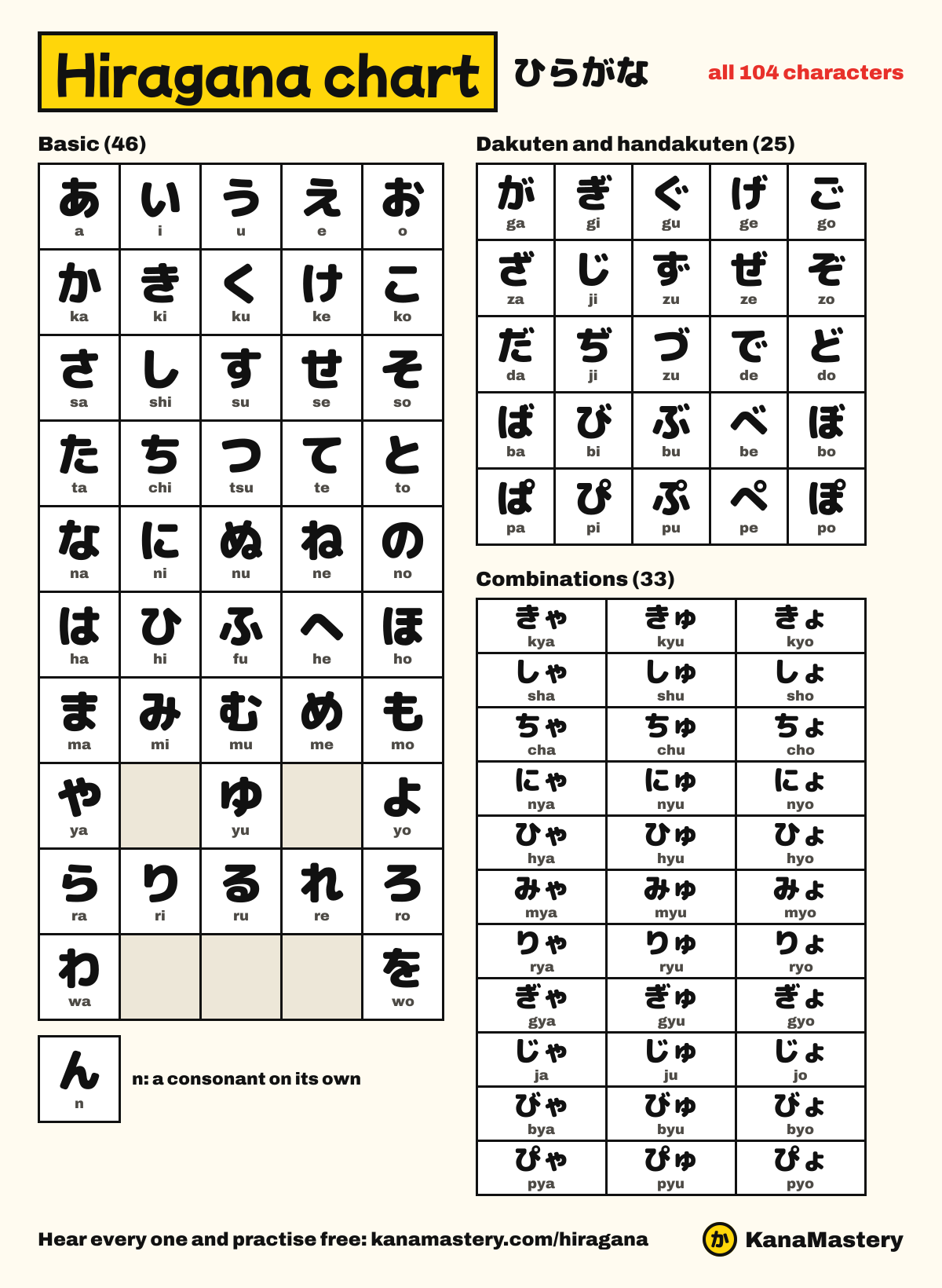
Hiragana is the first Japanese script to learn: 46 basic characters, each one sound. Japanese uses it for grammar (particles and verb endings), for native words, and to show how kanji are read. Here is the full chart with every sound, then how to learn it.
The hiragana chart (104 characters)
Tap a character for its sound, stroke order and words. “Quiz” under a row practises just that row, free, no account needed. Or test yourself on all of them: the hiragana quiz.
Basic hiragana (46)
Dakuten and handakuten (25)
んn: the only kana that is a consonant on its own.
The same chart in katakana: the katakana chart.
How to read the chart
- Columns are vowels, rows are consonants. Each kana is one sound: a consonant row (k, s, t…) plus a vowel column (a, i, u, e, o), so the k row is ka, ki, ku, ke, ko.
- A few don't follow the pattern: shi, chi and tsu in the s and t rows, fu in the h row. The y and w rows have only some of the five vowels.
- Two small marks change the consonant. Dakuten (゛) voices it: k becomes g, s becomes z, t becomes d, h becomes b. Handakuten (゜) turns h into p.
- A small ya, yu or yo joins the kana before it into one sound: ki with a small ya is kya.
How to learn hiragana
- A row at a time. Start with the vowels (あいうえお), then the k row, and so on down the chart. Five new sounds a session is plenty.
- Read before you write. Recognising a kana when you see it is what you need first; writing comes faster once you can read.
- Hear every one. Each character's page plays its sound, so you link the shape to the sound, not to the romaji.
- Read real words early. As soon as you know a few rows, read words made of them: it fixes the kana far better than drilling them alone.
- Review just before you forget. Short daily reviews beat long sessions. The free kana program does all of this, and Smart Review brings back the ones you're about to forget.
The look-alikes
The pairs learners mix up most. Open each to compare the strokes.
Where hiragana comes from
Hiragana grew out of man'yōgana, Chinese characters used for their sound, written in the flowing cursive style of calligraphy. Each hiragana is a simplified kanji:
What hiragana is for
Grammar
Particles such as は, を and に, and the endings of verbs and adjectives (okurigana), are written in hiragana.
Native Japanese words
Many everyday words are written in hiragana, especially when their kanji are rare or hard.
Reading aids
Furigana, the small kana printed above kanji, show how to read them. They are usually hiragana.
Children and beginners
Japanese children learn hiragana first, and books for young readers are written mostly in it.
Questions about hiragana
How many hiragana are there?
46 basic characters are in use today (two older ones, ゐ and ゑ, are no longer used). Adding the dakuten and handakuten marks gives 25 more sounds, and the small ゃ, ゅ and ょ give 33 combinations: 104 in all on this chart.
What is the difference between hiragana and katakana?
They write the same sounds. Hiragana is for grammar, native Japanese words and furigana; katakana is mostly for words from other languages, foreign names, sound effects and emphasis. Most learners start with hiragana, then katakana.
Is hiragana hard to learn?
No. It is a set of 46 shapes for 46 sounds, and many learners can read all of them after one or two weeks of short daily practice. The look-alikes (like ぬ and め) take the most attention.
Should I learn hiragana or kanji first?
Hiragana. It is in every Japanese sentence, kanji readings are written in kana, and dictionaries and textbooks expect you to read it.
Why is は sometimes read "wa"?
As the topic particle, は is pronounced wa, and the particles へ and を are pronounced e and o. Everywhere else they keep their usual sounds: ha, he and o.
Can you write everything in hiragana?
You can, and books for small children do. Adult Japanese mixes in kanji, because Japanese has no spaces between words and the kanji show where words begin and what they mean.
Read hiragana in a week or two
The free kana program teaches every hiragana a row at a time, with sound, then words, and Smart Review brings back the ones you're about to forget.
Kana origin: Wiktionary (CC BY-SA 4.0) · Romaji and audio: KanaMastery · All sources
History: Wikipedia, Hiragana (CC BY-SA 4.0).