Katakana chart and guide
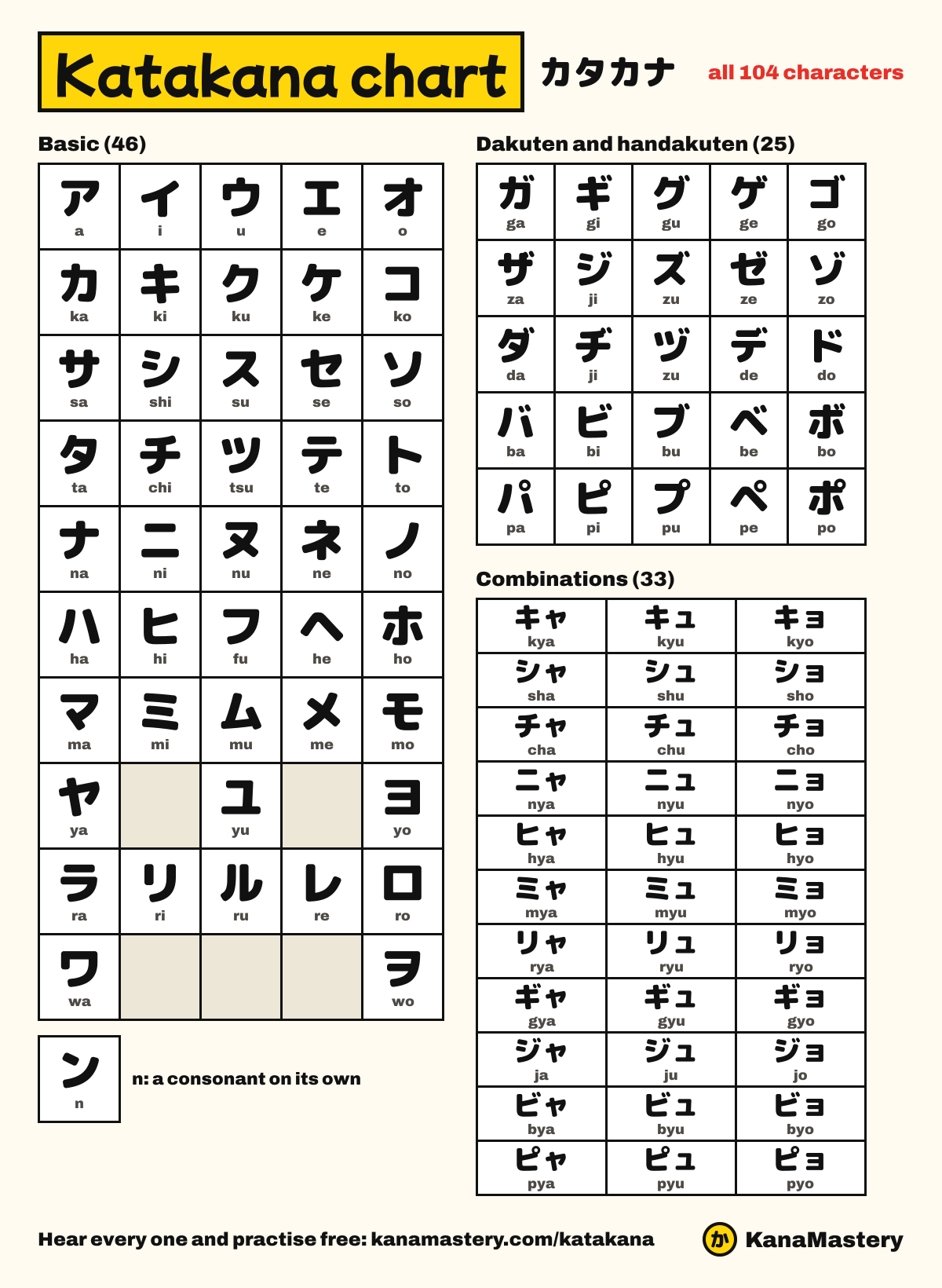
Katakana is the second Japanese script: the same sounds as hiragana, in sharper, straighter shapes. Japanese uses it for words from other languages, foreign names, sound effects and emphasis. Here is the full chart with every sound, then how to learn it.
The katakana chart (104 characters)
Tap a character for its sound, stroke order and words. “Quiz” under a row practises just that row, free, no account needed. Or test yourself on all of them: the katakana quiz.
Basic katakana (46)
Dakuten and handakuten (25)
ンn: the only kana that is a consonant on its own.
The same chart in hiragana: the hiragana chart.
How to read the chart
- Columns are vowels, rows are consonants. Each kana is one sound: a consonant row (k, s, t…) plus a vowel column (a, i, u, e, o), so the k row is ka, ki, ku, ke, ko.
- A few don't follow the pattern: shi, chi and tsu in the s and t rows, fu in the h row. The y and w rows have only some of the five vowels.
- Two small marks change the consonant. Dakuten (゛) voices it: k becomes g, s becomes z, t becomes d, h becomes b. Handakuten (゜) turns h into p.
- A small ya, yu or yo joins the kana before it into one sound: ki with a small ya is kya.
- A dash (ー) makes the vowel before it long in katakana words, as in コーヒー (kōhī, coffee).
How to learn katakana
- Learn it right after hiragana. The sounds are the same, so you're only learning new shapes for sounds you already know.
- A row at a time, vowels first, the same order as the chart.
- Give the look-alikes extra time. シ and ツ, ソ and ン differ only in the angle of their strokes: compare them side by side below.
- Read loanwords early. Katakana words are often English words in disguise, so reading them (テレビ, terebi, TV) is quick practice that rewards you fast.
- Review a little every day. The free kana program teaches katakana a row at a time, with sound, and Smart Review keeps it.
The look-alikes
The pairs learners mix up most. Open each to compare the strokes.
Where katakana comes from
Katakana was created in the 9th century by Buddhist monks, who took parts of man'yōgana (Chinese characters used for their sound) as a shorthand for reading texts. Each katakana is a piece of a kanji:
What katakana is for
Words from other languages
Loanwords are written in katakana: コーヒー (coffee, from English and Dutch), パン (bread, from Portuguese pão), アルバイト (a part-time job, from German Arbeit).
Foreign names
Names of people and places from outside Japan, and many company names, are written in katakana.
Sound effects
Onomatopoeia, the sound words manga is full of, are often in katakana.
Emphasis and science
A word can be put in katakana to stand out, like italics in English. The names of plants and animals in science are written in katakana too.
Questions about katakana
How many katakana are there?
46 basic characters, the same sounds as hiragana. With dakuten and handakuten there are 25 more, and with the small ャ, ュ and ョ another 33: 104 on this chart. Katakana also has a long-vowel dash (ー) and extra combinations for foreign sounds, such as ファ (fa) and ティ (ti).
What is katakana used for?
Mostly for words borrowed from other languages and for foreign names. It is also used for sound effects, for emphasis, for many company names, and for the scientific names of plants and animals.
Is katakana basically English?
No. Many katakana words come from English, but others come from Portuguese, Dutch, German and more, and all of them are adapted to Japanese sounds: "bread" is パン, from Portuguese.
Why is katakana hard to learn?
Mostly the look-alikes: シ (shi) and ツ (tsu), ソ (so) and ン (n) differ only in the angle of a stroke. Learners also see katakana less often than hiragana, so it needs regular review.
Should I learn hiragana or katakana first?
Hiragana first, then katakana straight after. Both use the same sounds, and hiragana appears in every sentence.
Read katakana in a week or two
The free kana program teaches every katakana a row at a time, with sound, then words, and Smart Review brings back the ones you're about to forget.
Words: JMdict · © EDRDG, CC BY-SA 4.0 · Kana origin: Wiktionary (CC BY-SA 4.0) · Romaji and audio: KanaMastery · All sources · This page's kanji and word data is shared under CC BY-SA 4.0.
History: Wikipedia, Katakana (CC BY-SA 4.0).